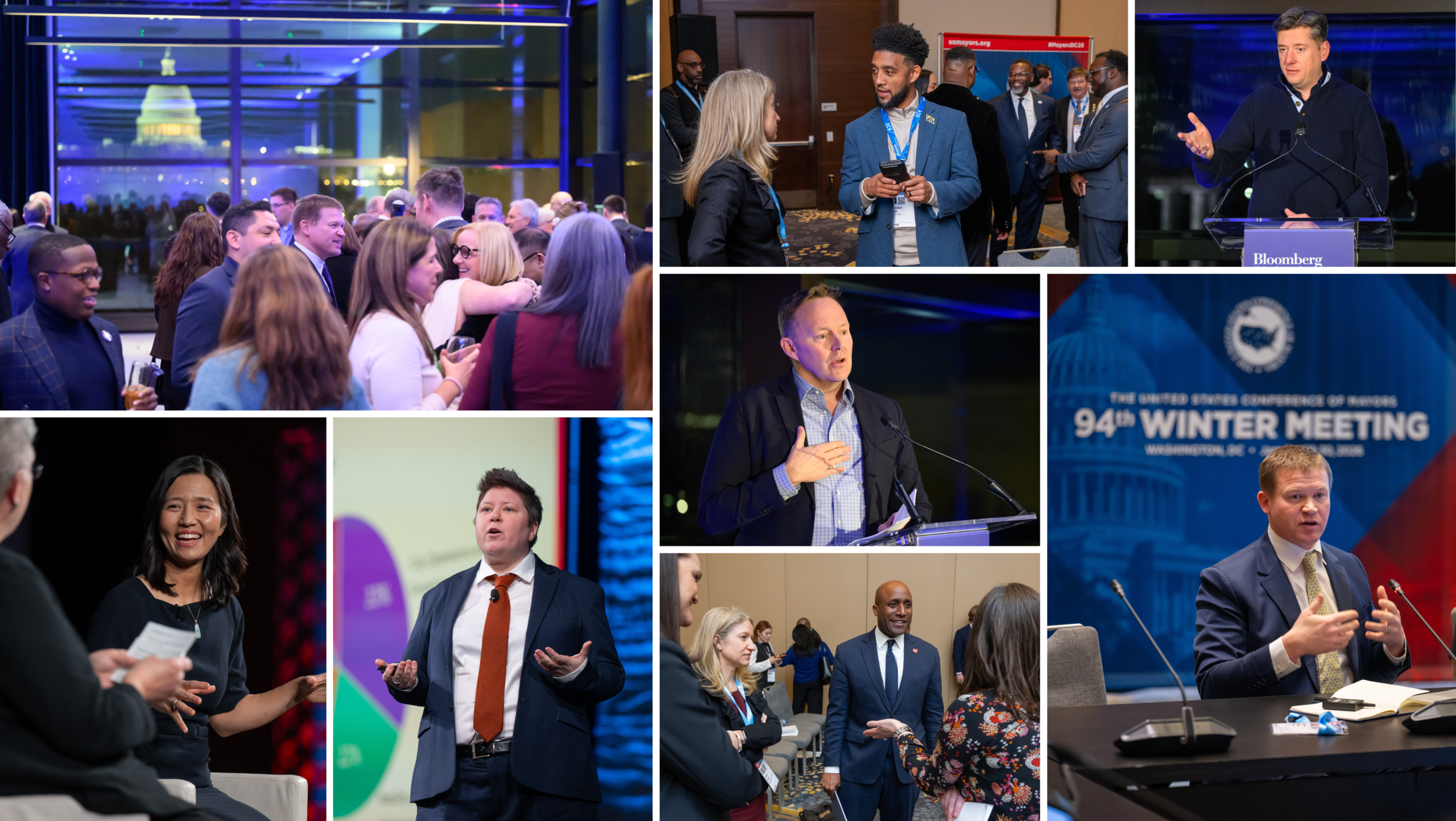
Clockwise from top left: Bloomberg Philanthropies’ reception at Hopkins Bloomberg Center on the eve of the US Conference of Mayors Winter Meeting; Baltimore Mayor Brandon Scott; Oklahoma City Mayor David Holt, President of the US Conference of Mayors, speaking at the Bloomberg Philanthropies reception; GovEx Executive Director Oliver Wise presenting at a breakout session on “AI-Powered Cities”; Kansas City Mayor Quinton Lucas, after moderating a panel on “New Approaches to Reducing Violence Crime”; Bloomberg Philanthropies’ Carrie Bishop; Boston Mayor Michelle Wu; Center: Bloomberg Philanthropies Government Innovation Lead James Anderson, speaking at the Bloomberg Philanthropies reception.
Despite a massive snowstorm that paralyzed much of the country, hundreds of mayors made it to Washington DC January 26 to 28 for the US Conference of Mayors Winter Meeting. Along with housing, public safety, and immigration, artificial intelligence was one of the hottest topics of conversation and mayors from cities in the Bloomberg Philanthropies City Data Alliance were often driving those conversations. (Watch recordings of plenary sessions here.)
On the eve of the convention, Bloomberg Philanthropies hosted a welcome reception at the Hopkins Bloomberg Center, where James Anderson, who leads the Philanthropies’ Government Innovation program, highlighted the imperative for cities to lead on AI adoption to benefit residents. Oklahoma City Mayor David Holt, President of the US Conference of Mayors, echoed him, noting the key role that cities play in driving innovation and thanking the Philanthropies for its long-term commitment to cities.
At the opening plenary, Bloomberg Philanthropies’ Carrie Bishop highlighted the ways cities are using AI – the highest portion, 33%, for city operations and governance – describing work in City Data Alliance cities like Bogota, Colombia, and encouraged mayors and their teams to explore City AI Connect and consider how participation in the Alliance could help them solve problems. The opening plenary also included a fireside chat with Mayor Holt and Mayor Muriel Bowser of Washington DC, which joined the Alliance in 2024.
In a breakout session presided over by the USCM Technology and Innovation Committee Chair Mayor Gina Ortiz Jones of San Antonio, GovEx Executive Director Oliver Wise talked to Boston Mayor Michelle Wu, who joined the Alliance last year, about how the city is using AI to improve its permit processes.
Wise then shared a presentation about the City Data Alliance’s approach to helping cities solve problems with AI. The Alliance, he says, posits that cities can leverage AI to solve their most pressing problems right now, without spending years developing infrastructure and guidelines.
“We think you can show value in the here and now, give your team and your staff cover to take risks, and then learn along the way and develop capacity,” he said, using Boston’s permitting innovation as an example. “Those successes that you’re having, Mayor Wu, in permitting or streamlining your notification systems – you can take that learning and that capacity and bring it elsewhere in your government to tackle new challenges.”
Mayor Wu also joined City Data Alliance peers Mayor Brandon Scott of Baltimore and Mayor Quinton Lucas of Kansas City in a session on “New Approaches to Reducing Crime,” which included discussion of data-based strategies to improve public safety, like Baltimore’s Gun Violence Reduction Strategy.
Virtually all mayors in attendance seemed to agree that AI was already having an impact in the lives of their residents. Many of the plenary and breakout sessions included robust, challenging conversations about the ways cities can and should embrace it.